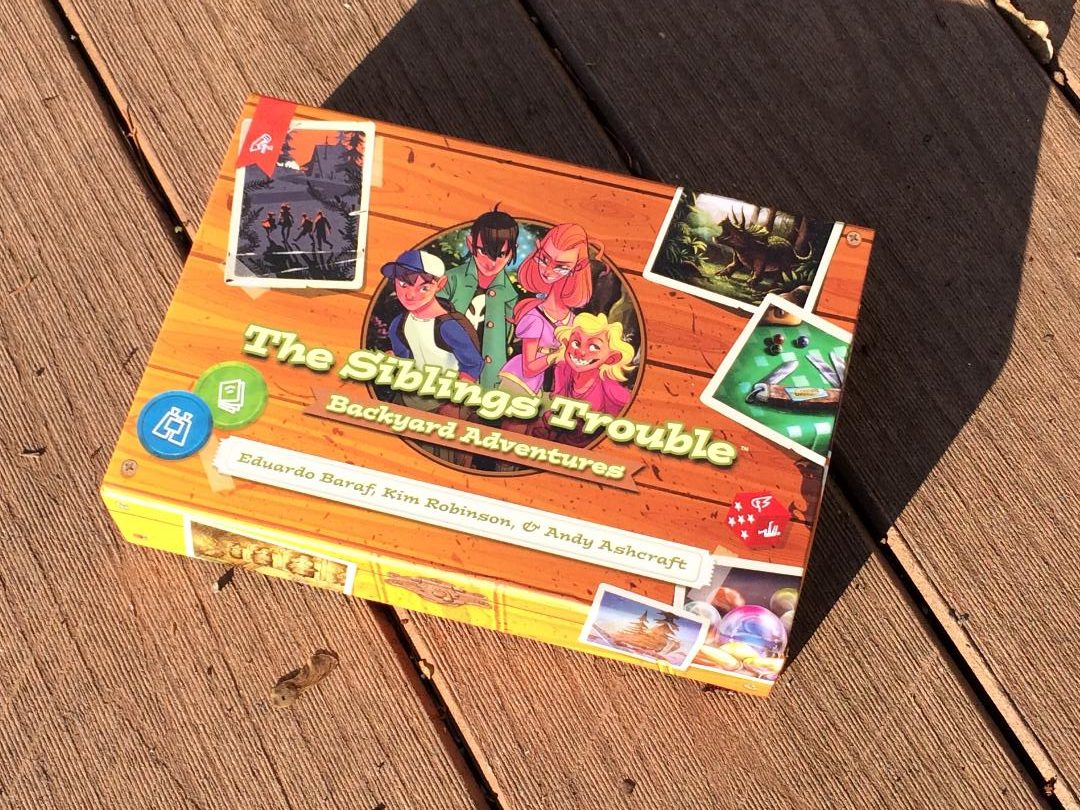
 The Siblings Trouble Backyard Adventures is a cooperative storytelling game for two to four players. Each player takes on the role of one of four siblings who go on an adventure in their neighborhood. The adventures use one of four locations that each has its own unique feel. The Mystic Waters includes underwater encounters with a very fairytale feel, with lots of merfolk, crabs, and fish. The Abandoned Junkyard is full of rats and robots. The Hillside Caves hide trolls and dwarves. And the Ancient Forest holds primordial dangers like dinosaurs and quicksand. Each location comes with an Entrance card and multiple Boss cards. The goal is to explore the location, defeat the boss, and safely return home.
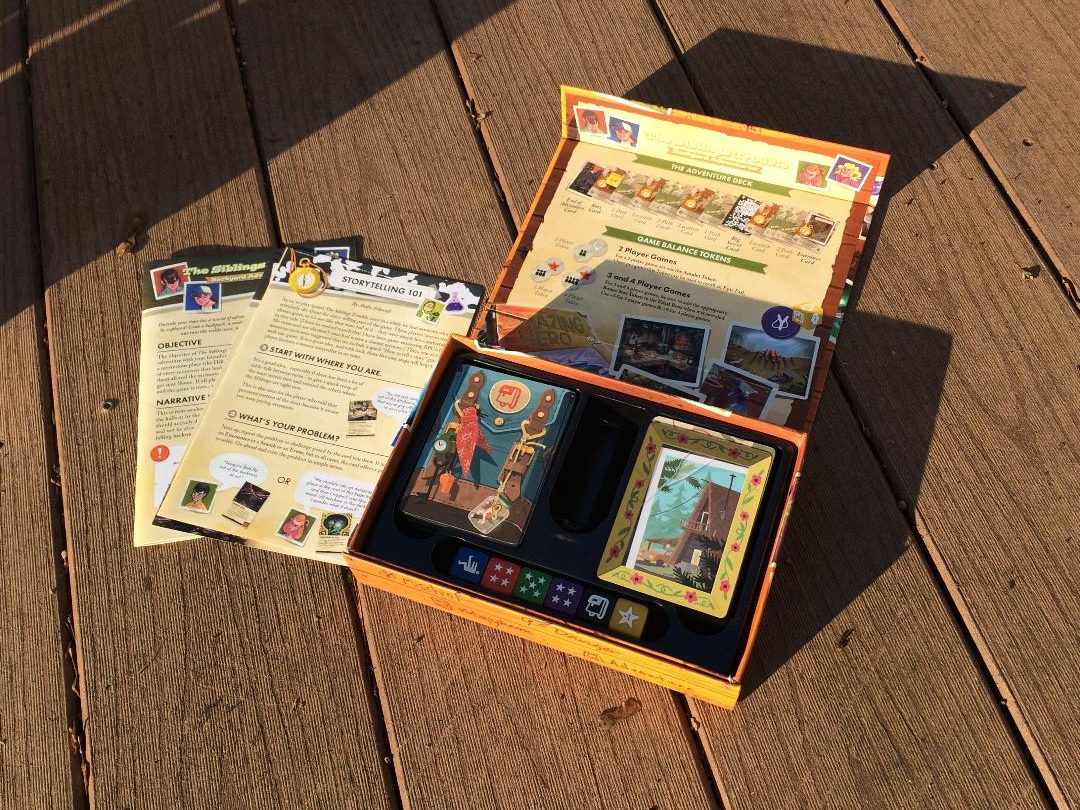
You use the Location cards, plus Path cards and a Big Secret card to build an adventure deck. The cards go in a specific order that will roughly result in a classic three-act structure to the story the players will tell of their adventure. At what would roughly be the end of the first act, players turn over their Big Secret card and the Boss card. From then on, the cards they reveal might make the Boss stronger or weaker, creating rising tension in the story as you approach the final conflict.
Players are encouraged (and sometimes mechanically rewarded) for turning the adventure described in the cards into a story. How did you use your slingshot to escape the giant crab? How is a book useful in warding off a swarm of bats? Success and failure is decided by a roll of the die as well as the expenditure of resources. This adds a random element to your storytelling. Suddenly, you don’t escape the giant crab. In fact, you suffer an epic fail! What happened? How did your attempt to use your slingshot backfire? You’ll need to be on your toes as a storyteller to roll both the good and the bad into your tale.
 If you fail to overcome an obstacle, you lose a turn and have to go back home. If everyone gets sent home, you lose. Otherwise, those who got sent home have to describe how they rejoined their siblings to continue the adventure together. After defeating the boss, you then have to describe how you returned home and, if you wish, how this lead to your next adventure.
If you like a lot of whimsy in your games, are always looking for an excuse to tell an exciting story, and enjoy the challenge and discovery that comes from adding a random element to your tall tales, Pencil First Games’ The Siblings Trouble Backyard Adventures is a game you’ll want to pick up. It’s for two-to-four players ages eight and up. There are options to adjust the game difficulty based on the number of players and also for those who just want a bigger challenge. Most games last about a half hour and there are also rules to daisy-chain your games into one big story. Find a copy at your Dragon’s Lair Comics and Fantasy® today.